
BUS 501: Business Perspectives #4
I think it’s fair to say that all of us have heard the terms economy and economics, but I wonder how many people without business backgrounds really knew what these terms meant. Often we hear terms like “economy is not doing so well..etc”, and I also knew loosely what these terms meant in a broader sense, so it was interesting for me to finally learn the proper definitions of these.
According to Klingensmith (2019), economics examines how individuals and firms make decisions regarding the allocation of limited resources. “Many students come into economics not really knowing what they will learn. Some students think issues like taxes and the stock market will be discussed. Others believe this is a course about money. None of those things are true. Instead, economics is the study of decision-making due to scarcity of resources.
As humans, our wants are unlimited. While we all have basic needs like food, water, and shelter, it is our desire for wants that puts a strain on the economy. Therefore, we need to decide how to best use our scarce resources. This is the crux of the study of economics.”.
Macroeconomics and Microeconomics are the two branches of economics. Macroeconomics centers on the economic systems of large entities like countries, regions, and governments whereas microeconomics studies the economic systems on a smaller scale, including individuals, companies, and small financial institutions. I found the following diagram to be a nice depiction of these concepts (UWorld, n.d.).

The economy on the other hand, is a complex system of interrelated production, consumption, and exchange activities, which ultimately determine how resources are allocated among participants. The production, consumption, and distribution of goods and services combine to fulfill the needs of those living and operating within the economy (Kenton, 2024).
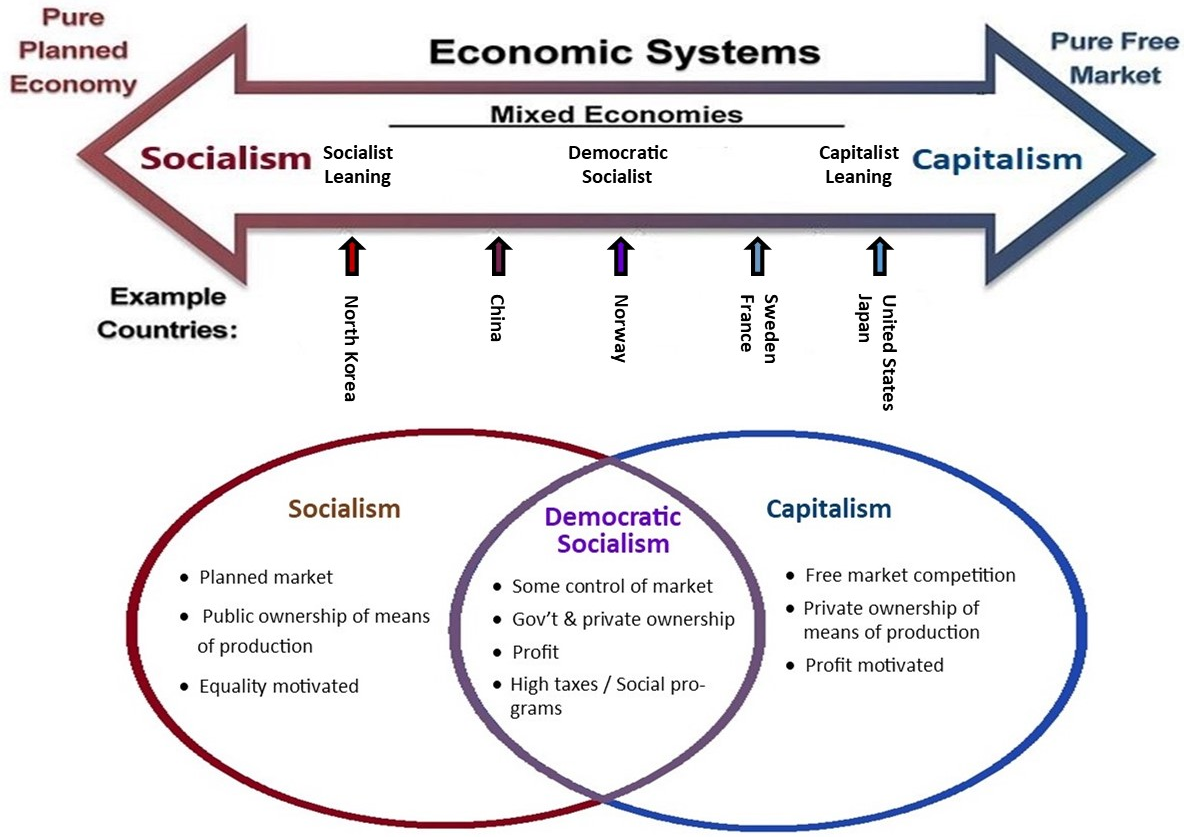
The two major economic systems in modern societies are capitalism and socialism. In practice, no one society is purely capitalist or socialist, and falls somewhere in the spectrum between the two as shown below. For example, the United States is a capitalist nation, but the government still regulates many industries to varying degrees (Ramirez, Latham, Hernandez, & Juskewycz, 2022).
References:
Klingensmith, J. Z. (2019). Introduction to microeconomics. https://psu.pb.unizin.org/introductiontomicroeconomics/
Kenton, W. (2024, August 20). Economy: What it is, types of economies, economic indicators. Investopedia. Retrieved January 17, 2025, from https://www.investopedia.com/terms/e/economy.asp
Ramirez, J. M., Latham, S., Hernandez, R. G., & Juskewycz, A. E. (2022). Types of economic systems. In Exploring our social world: The story of us (Chapter 11.3). Retrieved January 17, 2025, from https://pb.openlcc.net/socl120oerworkbook/chapter/11-3-types-of-economic-systems/
UWorld. (n.d.). Macroeconomics vs. microeconomics: Understanding the differences. Retrieved January 17, 2025, from https://collegeprep.uworld.com/ap/macroeconomics-vs-microeconomics/
 Thusitha Mabotuwana's Blog
Leave a comment