
This week we are learning about how to perform industry analysis using Porter’s Five Forces.
Understanding the competitive dynamics of an industry is essential for strategic planning and decision-making. By identifying the forces that shape profitability and competition, companies can develop strategies that set them up for success. One of the most popular frameworks for conducting industry analysis was developed by Michael E. Porter in 1979 (Porter, 2008). This framework helps assess the attractiveness of an industry and guides strategic decision-making.
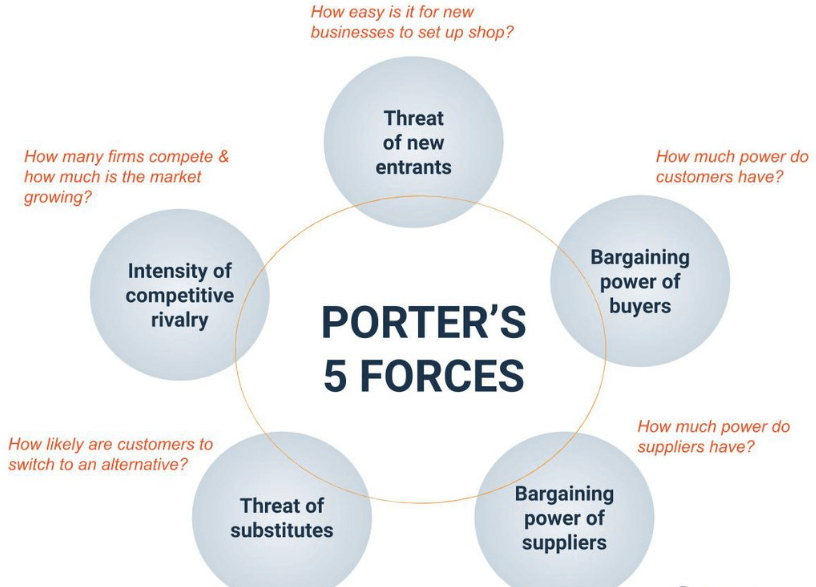
The Five Forces model outlines five key factors that influence competition and profitability within an industry. The five forces are:
1. Threat of New Entrants
This force examines how easy or difficult it is for new competitors to enter the market. When entry barriers are low, new entrants can enter easily and reduce the profitability of established businesses. Some of the types of entry barriers include: economies of scale, product differentiation, financial capital requirements, high switching costs, access to channels of distribution, and government policies to limit entry.
Example: The pharmaceutical industry has high entry barriers due to capital-intensive requirements and strict regulatory standards.
2. Bargaining Power of Suppliers
Suppliers’ bargaining power affects a company’s input costs and profitability. Powerful suppliers can demand higher prices or limit supply, squeezing profit margins. Some contributing factors here are: supplier concentration, lack of substitutes in the supply, and high switching costs.
Example: For instance, the tech industry often depends on rare materials like cobalt for batteries, giving suppliers significant bargaining power (Boyles, 2023).
3. Bargaining Power of Buyers
Buyers’ bargaining power determines how much influence customers have over pricing and terms. Factors such as buyer concentration, price sensitivity, buyers having a strong incentive to improve their profit
margins at the expense of suppliers (e.g., Walmart), and buyers having complete information about production costs can increase the bargaining power of buyers.
Example: Walmart’s massive purchasing volume gives it significant leverage over suppliers, allowing it to negotiate lower prices.
4. Threat of Substitutes
Substitutes refer to alternative products or services that can serve the same function from the point of view of the customer. A high threat of substitutes limits an industry’s pricing power and profitability. High availability of close substitutes, and low differentiation between products play a role here.
Examples: Using corn fructose sweetener instead of sugar, and streaming services like Netflix and Disney+ having mostly replaced traditional cable TV for their convenience and cost-effectiveness.
5. Industry Rivalry
The intensity of competition among existing companies is an important force that determines industry profitability. Factors such as number of competitors, industry growth, high fixed / storage costs, and low product differentiation affect the intensity of rivalry.
Example: The airline industry is known for intense rivalry due to high fixed costs, limited differentiation, and slow growth (Business News Daily, 2023).
I found this visual to capture the essence of these forces quite nicely (Young, n.d.):
While this model is a powerful tool, it has several limitations, including:
- It assumes a static industry structure, which may not apply in rapidly changing markets.
- It does not account for external factors like technological advancements or macroeconomic conditions.
- The framework may oversimplify complex industry dynamics.
Despite these limitations, Porter’s Five Forces remains a valuable framework for understanding competition and crafting strategic responses.
References
Business News Daily. (2023). Porter’s Five Forces: Analyzing the competition. Business News Daily. Retrieved from https://www.businessnewsdaily.com/5446-porters-five-forces.html
Boyles, M. (2023, July 27). What are business ethics & why are they important? Harvard Business School Online. Retrieved from https://online.hbs.edu/blog/post/business-ethics
Porter, M. E. (2008). The five competitive forces that shape strategy. Harvard Business Review, 86(1), 78-93. Retrieved from https://hbr.org/2008/01/the-five-competitive-forces-that-shape-strategy
Santa Clara University. (2019). Ethics in life and business. Santa Clara University. Retrieved from https://www.scu.edu/mobi/resources–tools/blog-posts/ethics-in-life-and-business/ethics-in-life-and-business.html
Young, A. (n.d.). Increase profitability with Porter’s Five Forces. J. Arthur & Co. Retrieved from https://jarthur.co/increase-profitability-with-porters-five-forces/
 Thusitha Mabotuwana's Blog
Leave a comment