
It was interesting to formally learn about some marketing concepts in class this week. The general impression I’ve had is that ‘marketing’ is essentially the set of activities companies use to promote their products or services, often through advertising and promotions, but seems like there’s more to it.
We learned that in marketing, two essential frameworks help businesses develop effective strategies (Villegas, 2024): the 5Cs (Company, Customer, Competitor, Collaborator, and Context) and the 4Ps (Product, Price, Place, and Promotion). These concepts guide companies in understanding their market environment and positioning their products successfully.
The 5Cs of Marketing
- Company – Businesses must evaluate their strengths, weaknesses, and market positioning to create a sustainable competitive advantage. This includes brand reputation, financial resources, and innovation capabilities (Kotler & Keller, 2016).
- Customer – Understanding target customers, their needs, and purchasing behaviors helps in tailoring products and marketing messages effectively. Successful companies conduct market research to anticipate changing preferences.
- Competitors – A firm must analyze competitors’ strengths and weaknesses to differentiate its offerings and develop a competitive edge. Xiaomi, for instance, competes with Apple and Samsung by offering high-spec smartphones at lower prices (Mozur, 2021).
- Collaborators – Strong partnerships with suppliers, distributors, and influencers can enhance a company’s reach and efficiency. Collaborations with retailers or tech influencers can boost brand credibility and sales.
- Context – External factors like economic trends, regulations, and technological advancements influence marketing strategies. Companies must adapt to these macro-environmental changes to stay relevant.
The 4Ps of Marketing
- Product – A successful product meets customer needs and offers a unique value proposition. Xiaomi designs feature-rich yet affordable smartphones to attract budget-conscious consumers.
- Price – Setting the right price balances profitability and market demand. Competitive pricing, discounts, and financing options help attract price-sensitive customers.
- Place – Distribution channels must be optimized to ensure product availability. Xiaomi leverages direct online sales and limited physical retail stores to reduce costs.
- Promotion – Marketing campaigns, advertising, and brand communication shape consumer perception. Digital marketing, influencer partnerships, and social media engagement are crucial in today’s digital landscape (Chaffey & Ellis-Chadwick, 2019).
By integrating the 5Cs and 4Ps, businesses can create well-rounded marketing strategies that drive growth and customer engagement. Successful brands continuously analyze and adapt to market changes to maintain a competitive edge.
Integrating these concepts with Segmentation, Targeting, and Positioning (STP) ensures businesses effectively reach their ideal audience. Segmentation involves dividing the market into distinct groups based on demographics, behaviors, or psychographics; Targeting selects the most promising segments to focus marketing efforts efficiently; and Positioning establishes a unique brand perception in consumers’ minds, emphasizing differentiation and value.
This image the interactions between these concepts pretty well I think (Lacobucci, 2013):
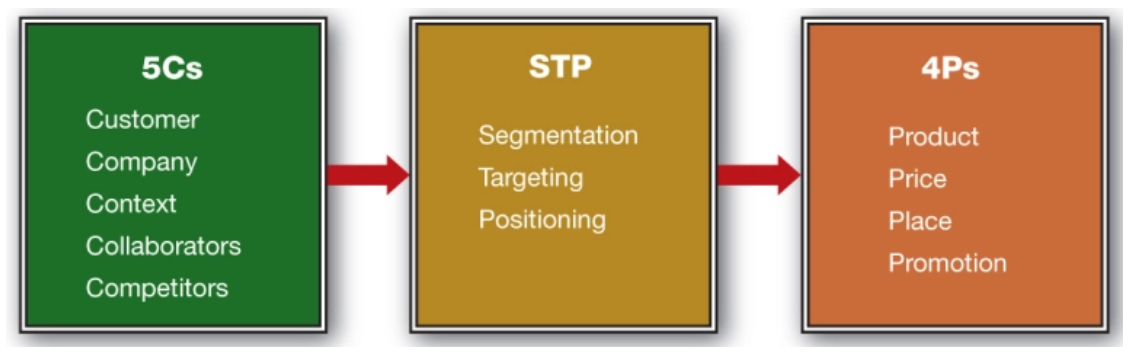
By aligning the 5Cs and 4Ps with STP, businesses create informed, data-driven strategies that maximize market impact and customer satisfaction.
References
- Chaffey, D., & Ellis-Chadwick, F. (2019). Digital marketing: Strategy, implementation, and practice (7th ed.). Pearson. Retrieved from https://hisp.htmi.ch/pluginfile.php/75370/mod_resource/content/1/Book%20-%20Digital%20Marketing%20-%202019%20%28Chaffey%20and%20Ellis-Chadwick%29.pdf
- Kotler, P., & Keller, K. L. (2016). Marketing management (15th ed.). Pearson. Retrieved from https://students.aiu.edu/submissions/profiles/resources/onlineBook/S3D7W4_Marketing_Management.pdf.
- Lacobucci, D. (2013). MM4: Marketing Management. South-Western, Cengage Learning.
- Mozur, P. (2021, August 23). The world’s hottest smartphone brand is Chinese—and it isn’t Huawei. The Wall Street Journal. Retrieved from https://www.wsj.com/articles/the-worlds-hottest-smartphone-brand-is-chineseand-it-isnt-huawei-11629711005
 Thusitha Mabotuwana's Blog
Leave a comment