
It’s that time of the year again where most employees need to sign up for their healthcare plans for 2014 (assuming you are getting insurance through your employer). There seem to be all sorts of healthcare plans like PPO, ABHP/HSA/HDP, HMO, EPO, POS etc (here are a couple of references that discuss what all the acronyms mean 1, 2) and it can be difficult to compare which one to go with. Most employers offer at least two plans to select from, so if your spouse’s employer also offers insurance, you’ll have 4+ options to select from!
The PPO plan and the relatively new high-deductible plan – HDP (generally referred to as an HSA or an Account Based Healthcare Plan – ABHP) seem to be two commonly offered healthcare plans, at least based on various forums I’ve read. I felt like comparing the cost differences between these two plans was an interesting problem to spend some time on and share with others.
If you just Google “PPO vs HSA” you’ll come across many forums and the consensus seems to be that the HSA is better if you are generally healthy. There are several calculators around as well (e.g., mywealthcareonline, aarp) that let you compare different plans, but I wanted to see how the total cost changes depending on your plan and medical expenses.
I’m not going to discuss the plan differences here, but here are some quick facts I have learnt:
PPO with FSA
– You have to be on the PPO plan to have an FSA account.
– You need to determine roughly how much expenses you would incur in the upcoming year to put the right amount in the FSA.
– FSA money is available for you to spend on January 1st, and you pay this amount out of your paycheck over the year.
– You can’t add funds to your FSA in the middle of the year.
– You need to use your money in FSA by 31st Dec, or else you lose it.
– General idea with PPO is to pay a higher premium upfront, and let insurance kick-in after meeting a relatively lower deductible (sometimes also a lower annual out-of-pocket maximum).
– Typically, insurance coverage for prescription drugs will kick-in immediately with PPO plans without having to meet the deductible first.
ABHP with HSA
– You have to be on the ABHP plan to have an HSA account.
– Most employers will make some contribution to your HSA to help you with meeting the relatively higher deductible (could also be a higher OOP maximum).
– What you can use out of the HSA is whatever you have there – i.e., employer contribution plus whatever you have paid out of your paycheck so far.
– You can contribute to the HSA on an ongoing basis (unlike the FSA). All these contributions are pre-tax dollars.
– Any leftover balances from the HSA carry over to next year, so this could be a good option if you are looking for a long term healthcare expense account.
– General idea is to pay a lower premium out of your regular paycheck, but be ready to pay a higher deductible and OOP cost if needed.
Like most of you who’d be reading this post, I’m also a regular employee and no expert on healthcare plans, so please don’t take what I’m writing here as solid and accurate advise. It’s entirely based on my understanding of the two plans after reading various documents and forums, so I’m open to suggestions (perhaps based on your own experience?).
Using hypothetical numbers (for deductible, premiums etc), I tried out a few scenarios, but it’s difficult for me to find any realistic scenario where the PPO makes sense for most people. Following is the graph I came up with:
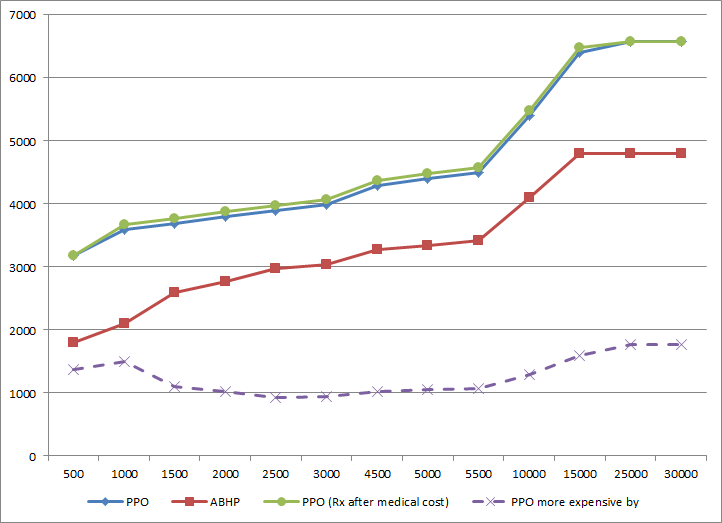
Disclaimer: Note that I’ve tried to keep the numbers realistic as possible in the sample worksheet assuming a relatively healthy family and nothing to do with what a specific employer provides. PPO and ABHP are Federal plans and largely function the same way across the board, although the actual plan is administered by the individual employer subject to all sorts of variations to the numbers and other conditions. My wife’s or my employer may or may not be providing these plans.
I have attached the Excel sheet (
) which also contains all the formulas. The cells highlighted in blue are the only ones you need to change to customize it to suit your own situation. Let’s work through one specific example.
Example: A family incurs $300 in prescriptions, and subsequently $4,500 in medical costs. Following are the parameters we have to work with assuming you put in $500 to FSA and employer gives $1,000 to kick-start the HSA:
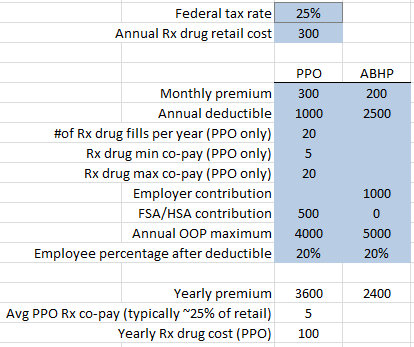
Annual premiums are $300×12 = $3,600 and $200×12 = $2,400 respectively.
Under the PPO plan, co-insurance for prescriptions kick-in immediately, but you need to pay something between the min and max co-pays every time you buy drugs. The actual co-insurance you have to pay for drugs can vary quite a bit depending on whether you buy generic (Tier 1), preferred (Tier 2) or non-preferred (Tier 3) brand name drugs since each class is covered at different percentages, and also have different min/max co-pays. So to keep things simple, I’m assuming 25% is the co-pay. So in the example, the average co-pay per visit to pharmacy would be:
$300 x 25% / 20 (i.e., each time you’ll need to pay 25% of cost, or min or max co-pay) which is $3.75. In this case you need to pay the min co-pay which is $5. Now $5 times 20 visits gives us a total y $100 for Rx drugs for the year – i.e.,

Now you pay this $100 out of the FSA which will also go towards the deductible.
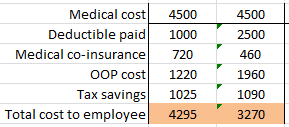
Then for the $4,500 medical bill, you will first pay $900 which will go towards the PPO deductible (out of which $400 will come from FSA). Now that the $1,000 deductible is met, co-insurance comes in for $3,600 and you’ll need to pay $3,600 x 20% = $720. There’s no more money left in the FSA, so this will be an OOP expense. You had to pay $500 OOP to meet deductible, and $720 in co-insurance, so the total OOP is $1,220. Tax savings was (premium + FSA amount)*tax rate = (3600 + 500) * 25% = $1,025. Total cost to employee therefore is (premium + FSA amount + OOP – tax savings) = (3600 + 500 + 1220 – 1025) = $4,295.
For the ABHP case, things are a bit more straight-forward. Let’s look at the what you need to pay part first. You pay the retail $300 for Rx and $2,200 of the medical bill to meet the $2,500 deductible. Then co-insurance kicks in which will be (4,500-2,200) x 20% = $460. As for the how to pay part, you had $1,000 in the HSA, so you need to find a $1,500 + $460 = $1,960 out of pocket. You’ll make a pre-tax HSA contribution at this point. So altogether, the tax saving would be (premium + HSA contribution) x 25% = (2400 + 1960) x 25% = $1,090. Total cost of employee is: (2400+1960-1090) = $3,270.
Above two calculations are highlighted in the Excel sheet:
I think for most people the ABHP is beginning to make more sense as long as you can afford to come up with the high deductible in case of emergency. There are various other benefits too with the HSA; for instance, take a look at the following for some decent discussion:
http://www.mayoclinic.com/health/health-savings-accounts/GA00053
http://www.benefitspro.com/2012/04/02/five-reasons-to-enroll-in-an-has
http://www.foxbusiness.com/personal-finance/2012/05/03/tax-benefits-opening-health-savings-accounts/
At the same time, a study from 2006 “GAO Study Confirms Health Savings Accounts Primarily Benefit High-Income Individuals” shows that “51 percent of tax filers making HSA contributions in tax year 2004 (the first year HSAs were available) had adjusted gross income of $75,000 or more.”, so this may not be for everyone. I’m thinking there’s some strong correlation between this study findings, and the high deductible you need to meet with the ABHP accounts.
As long as you can afford the high deductible, I think the only time the PPO would make sense is if you need a lot of maintenance drugs which are also expensive. For instance, if we change the $300 for Rx drugs to $15,000, the graph changes so that the PPO would make more sense:

I hope this post will shed some light on the cost differences between the PPO and the high-deductible plans. Feel free to share your thoughts and also point out if I have done anything wrong in my calculations.
 Thusitha Mabotuwana's Blog
Could we have have dual medical plans? My employer’s PPO family plan as my primary carrier and my wife’s employer HDP plan as a secondary carrier.
Company HR will usually be the best resource to answer this question, but there shouldn’t be any issues having dual plans. Unless there’s a specific need, I would think it’ll be somewhat a waste though, since most likely you will never use the secondary plan, although you’re paying for it. On a personal note, I have been on my employer’s plan while my wife and daughter were on my wife’s plan simply because their plan was a bit better. There is a working spouse surcharge however, so it made some sense for me to have my own, although that arrangement means in a really bad year, we will need to meet the individual out-of-pocket maximums independently.